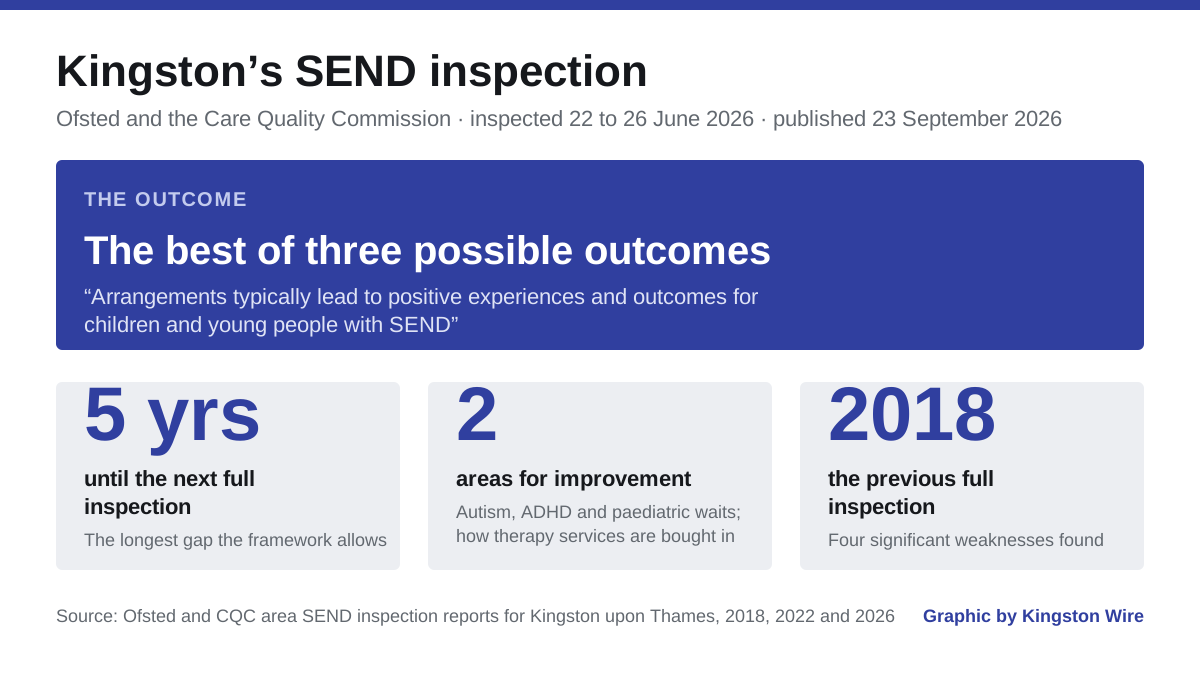

Ofsted and the CQC gave Kingston's SEND partnership the best of three possible outcomes on 23 September, and told it to cut autism and ADHD waits.
Kingston’s services for children with special educational needs and disabilities have been given the best of the three outcomes an area SEND inspection can award. The report by Ofsted and the Care Quality Commission was published on Wednesday 23 September, three months after inspectors spent a week in the borough.
Their finding, in the report’s own words, is that the partnership’s arrangements “typically lead to positive experiences and outcomes for children and young people with SEND”, and that it “is taking action where improvements are needed”.
That is the top of three possible outcomes in Ofsted’s area SEND framework. It carries the longest gap before the next visit. Kingston will not face another full inspection for about five years. Areas given the middle outcome are re-inspected in roughly three years, and the worst outcome triggers a priority action plan and a monitoring inspection inside 18 months.
Inspectors were in Kingston from 22 to 26 June. They looked at the local area partnership, which is not the council alone. It is Kingston Council, the community interest company Achieving for Children that runs education and children’s social care on the council’s behalf, and NHS South West London Integrated Care Board.
Eight years ago this was a written statement of action
The result reads differently once you put it next to the last two inspections.
In September 2018 the same two inspectorates found Kingston wanting. The inspection letter of 23 October 2018 said the inspection “raises significant concerns about the effectiveness of the local area”, and required a written statement of action. Four weaknesses had to be fixed:
- the overall poor quality and monitoring of EHC plans, including contributions from health professionals
- the timeliness of the annual review process and any amendments to EHC plans
- the strategic leadership and monitoring of the clinical commissioning group’s work on the 2014 reforms
- the relationship between parents and parent representatives, including a parent carer forum
That statement was declared fit for purpose on 6 March 2019. Inspectors came back from 4 to 6 October 2022 to check. Their revisit letter found the area had made sufficient progress on all four.
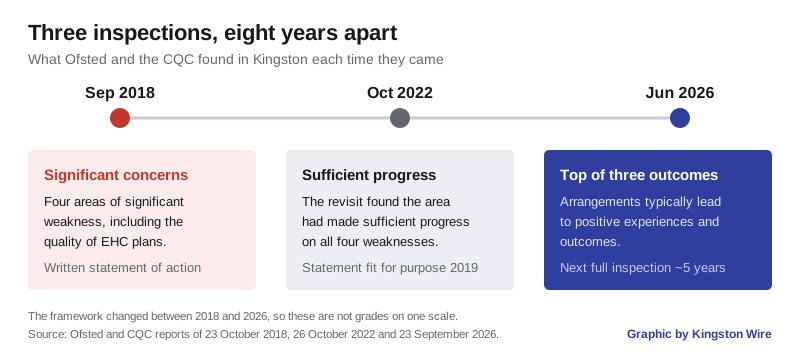
The frameworks changed in between, so the 2026 outcome is not a grade on the same scale as 2018. What is comparable is the direction. In 2018 the borough was told to write an action plan. In 2026 it is being left alone for five years.
What inspectors found working
The report runs to nine pages and most of it is positive. Some of it is unusually specific for an inspection document.
- Identification in the early years is “notably a strength”, helped by training for school and nursery staff and a 0 to 19 health visiting and school nursing offer the report calls “flexible, dedicated and responsive”.
- EHC plans are “issued in a timely way” and annual reviews are “mostly timely”. That is the 2018 weakness, reported as fixed.
- Attendance is “typically high”, which inspectors read as a sign of belonging. The number of children with SEND educated at home or outside education has “markedly decreased”.
- Children and young people with SEND in Kingston “outperform their peers nationally”, across all phases of education.
- The number not in education, employment or training has “significantly decreased in recent years”, which the report puts down to preventative work picking up young people at risk at their annual review.
- Support into adulthood from social care is “highly effective”, with work experience, supported internships and a virtual school that stays with 18 to 25 year olds.
Inspectors also named services by name: the Non-Violent Resistance programme run by CAMHS, the Aiming High initiative, the Education Inclusion Support Service, the mental health support team in schools, the dysphagia pathway, the More Than Words and iChatter workshops, and the TAG youth club for disabled young people.
The two things it has to fix
Ofsted and the CQC set out two areas for improvement. Both are about health, and both are about waiting.
The first is stated as: “Partnership leaders should reduce the time that children and young people with SEND must wait to access a range of health services and ensure families benefit fully from the range of available support while waiting. These include assessment of autism and/or ADHD and community paediatrics.”
The second is about how those services are bought in: “Partnership leaders should ensure that the approach to commissioned services, particularly for occupational therapy and continence services, are implemented with consistent precision.”
The body of the report is blunter than the summary. It says a few health services are not commissioned in a way that fully meets children’s needs, and that there has been “an over-reliance on spot commissioning and too little oversight of how it is used”. The consequence, in the inspectors’ words, is that “the offer can be variable and can be limited to those children and young people with SEND who require an education health and care needs assessment”.
Two further criticisms sit in the same section:
- transition from child to adult health services, including speech and language, is “not managed swiftly and can be difficult to navigate”, which “sometimes leaves young people with SEND without the right support”
- the tracking of what help families have been offered, or have taken up, while they wait “is not always clear”
The parent carer forum, the SEND parent champions and the SEND consortium are all described as very active and able to challenge the partnership. The report adds that they “at times wish their participation could be at an earlier stage”.
The waiting list behind the finding
The report does not put a number on the autism and ADHD waits. The NHS does.
Kingston sits inside NHS South West London Integrated Care Board, which also covers Croydon, Merton, Richmond, Sutton and Wandsworth, so the published figures are for all six boroughs rather than Kingston alone. They are taken from the month inspectors were in the borough.
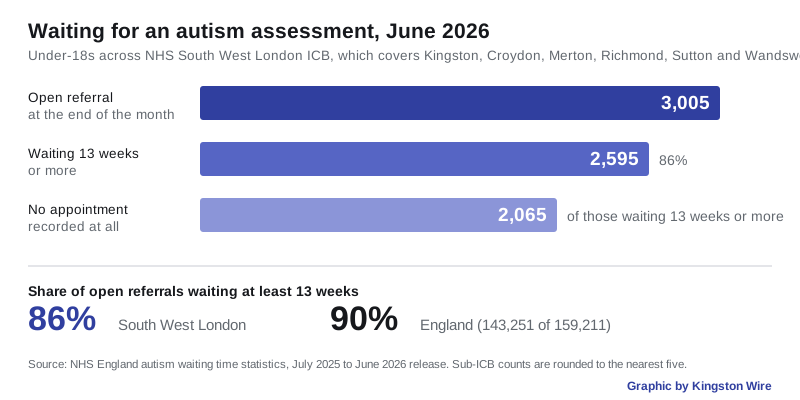
In June 2026, across that six-borough area:
- 3,005 children and young people aged under 18 had an open suspected autism referral
- 2,595 of them had been waiting at least 13 weeks, which is 86%
- 2,065 of those long waiters had no care contact appointment recorded at all
The national picture is no better, and on the headline measure it is slightly worse. Across England in the same month, 159,211 under-18s had an open referral and 143,251 of them, 90%, had waited at least 13 weeks.
NHS England calls 13 weeks “the recommended” wait for a first appointment. It is not a legal limit and there is no penalty for missing it. In June 2026, 4% of long-waiting under-18s in the South West London area had been seen inside it.
What the council says
Councillor Sue Ansari, the portfolio holder for children’s services, called it “a really positive report” in the council’s announcement, and said inspectors “saw a positive partnership that listens to children and young people and puts their needs first”.
She did not dodge the rest of it. “We also recognise there is more to do, particularly on waiting times for some health services,” she said. “We’re committed to working with our partners to close that gap.”
The council also points out that the inspection follows an Outstanding judgement for Kingston’s children’s services in an inspection of December 2024, published in January 2025, where every one of the four sub-judgements was also outstanding.
What it means for you
If your child has an EHC plan or is waiting for one, three things follow from this report.
A published plan is coming. Ofsted and the CQC have asked the partnership to update and publish its strategic plan based on the two recommendations. That document is where you will be able to see what the partnership actually intends to do about the waits, and by when. It has not been published yet.
The waiting-list problem is now on the record. Until this week, a family waiting for an autism or ADHD assessment had the council’s own assurances and little else. There is now an inspection finding, from two national regulators, that says the wait is too long and that support while waiting is not properly tracked. That is a stronger thing to quote in a complaint or an appeal than a press release.
Nobody is coming back for five years. There will be engagement meetings with the inspectorates in between, but no further full inspection until around 2031.
For advice in the meantime, the SEND information, advice and support service is jointly commissioned across Kingston and Richmond and the report describes it as “well received by parent carers”. The Kingston Parent Carer Forum is the independent route, and was one of the groups inspectors spoke to.
The inspection was led by Sarah Saunders HMI for Ofsted and David Roberts for the CQC. Ian Dodds is Kingston’s executive director of children’s services.
Separately, the council is looking for an architect to design a new electric vehicle depot for the SEND transport fleet in Chessington, and says the fleet has to expand.
Sources
- Area SEND inspection of Kingston upon Thames Local Area Partnership, Ofsted and the Care Quality Commission, inspected 22 to 26 June 2026, published 23 September 2026, for the outcome, the findings, the two areas for improvement and the inspection team.
- Area SEND inspections: framework and handbook, Ofsted, for the three possible outcomes and what follows each one.
- Joint local area SEND inspection in Kingston upon Thames, letter of 23 October 2018, for the four areas of significant weakness and the written statement of action.
- Joint area SEND revisit in the Royal Borough of Kingston upon Thames, letter of 26 October 2022, for the finding of sufficient progress on all four.
- Inspection of Royal Borough of Kingston upon Thames children’s services, Ofsted, inspected 2 December 2024, published 29 January 2025, for the outstanding judgements.
- Autism Statistics, July 2025 to June 2026, NHS England, published 13 August 2026, for the open referral and waiting figures for NHS South West London ICB and England in June 2026. Sub-ICB counts are rounded to the nearest five.
- Ofsted and CQC praise Kingston’s support for children and young people with SEND, Royal Borough of Kingston upon Thames, 23 September 2026, for Councillor Ansari’s comments.
Have your say